
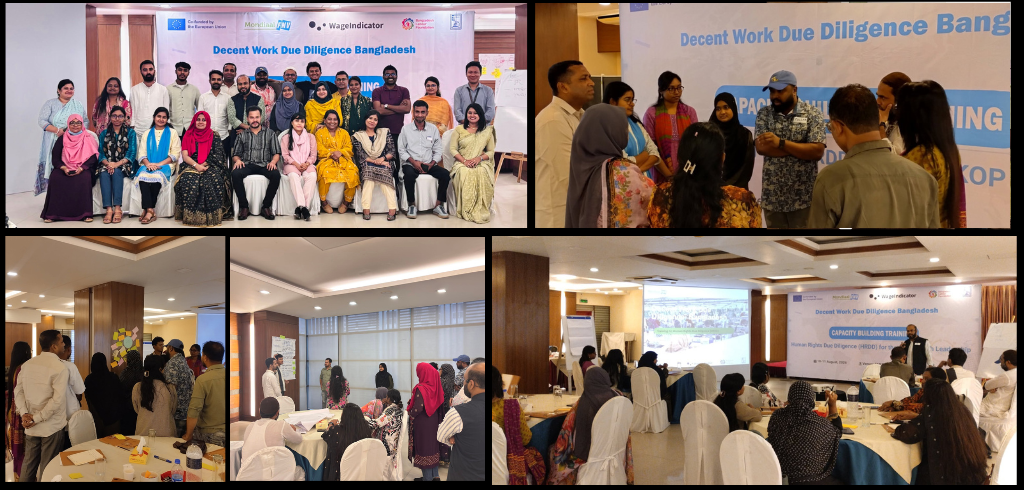
The Human Rights Due Diligence (HRDD) Capacity Building Training for young leaders of Sromik Kormochari Oikya Parishad (SKOP) was organized on 10–11 August 2026 by Bangladesh Labour Foundation (BLF), in collaboration with Mondiaal FNV versterkt werknemers wereldwijd and the Bangladesh Institute of Labour Studies (BILS), to strengthen trade unions’ capacity to identify human rights risks, raise workplace concerns, and influence decisions affecting workers’ lives.
The two-day training was organized under the Decent Work Due Diligence Bangladesh (DWDDB) Project, jointly implemented by Mondiaal FNV versterkt werknemers wereldwijd, WageIndicator Foundation, BLF, and BILS, with co-funding from the European Union in Bangladesh.
𝗦𝘁𝗿𝗲𝗻𝗴𝘁𝗵𝗲𝗻𝗶𝗻𝗴 𝗧𝗿𝗮𝗱𝗲 𝗨𝗻𝗶𝗼𝗻𝘀 𝗳𝗼𝗿 𝗘𝗳𝗳𝗲𝗰𝘁𝗶𝘃𝗲 𝗛𝘂𝗺𝗮𝗻 𝗥𝗶𝗴𝗵𝘁𝘀 𝗗𝘂𝗲 𝗗𝗶𝗹𝗶𝗴𝗲𝗻𝗰𝗲
The training focused on equipping young trade union leaders with practical knowledge of HRDD and Responsible Business Conduct, enabling them to engage more effectively with employers, global brands, and buyers to promote respect for human and labour rights across supply chains.
Key Discussions
Understanding Human Rights Due Diligence (HRDD) and Responsible Business Conduct
Exploring international labour and human rights standards and emerging due diligence legislation
Understanding the six-step HRDD process and its practical application in workplaces and supply chains
Strengthening trade unions’ capacity to identify human rights risks, raise concerns, and advocate for workers’ rights
Exploring grievance mechanisms established by global brands and buyers to address workplace concerns and human rights violations
Promoting meaningful worker participation and stronger trade union engagement in due diligence processes
Through this initiative, BLF and its partners continue to strengthen trade union capacity to ensure that workers’ voices are heard and their concerns are addressed. By empowering young trade union leaders with practical HRDD knowledge and advocacy skills, the DWDDB Project contributes to more accountable business practices, stronger worker representation, and meaningful human rights due diligence across global supply chains.