
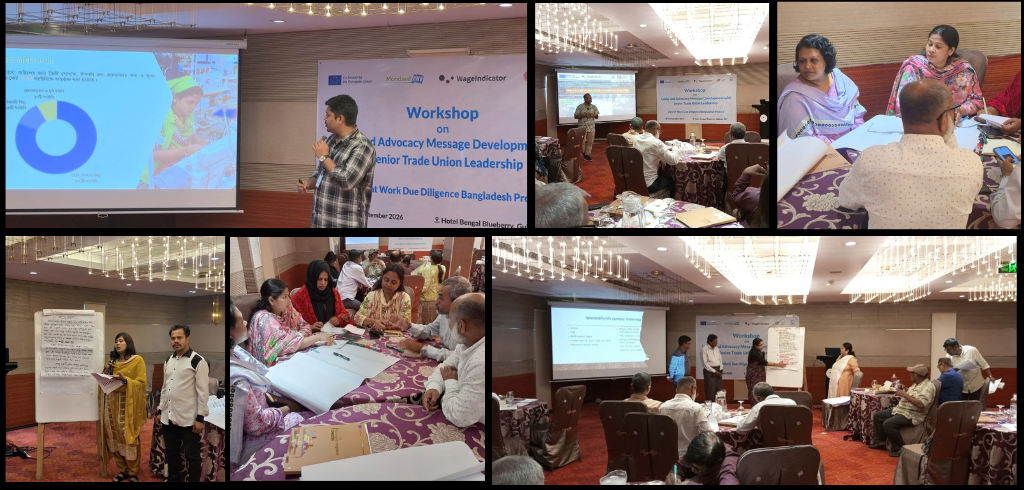
The “𝗧𝘂𝗿𝗻𝗶𝗻𝗴 𝗪𝗼𝗿𝗸𝗲𝗿𝘀’ 𝗘𝘃𝗶𝗱𝗲𝗻𝗰𝗲 𝗶𝗻𝘁𝗼 𝗔𝗰𝘁𝗶𝗼𝗻𝗮𝗯𝗹𝗲 𝗔𝗱𝘃𝗼𝗰𝗮𝗰𝘆” two-day Advocacy Message Development Workshop for Trade Unions was co-organized by Bangladesh Labour Foundation (BLF), Mondiaal FNV, and Bangladesh Institute of Labour Studies (BILS) on 19–20 September 2026 in Dhaka.
The workshop was held under the Decent Work Due Diligence Bangladesh (DWDDB) Project, implemented by BLF in partnership with Mondiaal FNV, WageIndicator Foundation, and BILS, with support from the European Union in Bangladesh.
The workshop brought together senior and mid-level trade union leaders on 19 September, followed by youth and women representatives on 20 September, creating an inclusive platform to strengthen trade union advocacy capacities and ensure diverse workers’ voices are reflected in advocacy processes.
Strengthening Evidence-Based Trade Union Advocacy
As part of the workshop, BLF presented key findings from the Decent Work Due Diligence Check Survey and Workers’ Priority Poll (WPP), providing an evidence base for participants to identify key sectoral concerns, workplace challenges, and priorities of workers.
The workshop focused on translating these findings into clear, focused, and evidence-based advocacy messages that can support meaningful engagement with decision-makers and relevant stakeholders.
Key Discussions
- Identifying specific workplace and sectoral problems based on workers’ experiences and evidence
- Using research findings and workers’ priorities to develop credible and focused advocacy demands
- Linking identified concerns with relevant national laws and international labour standards
- Identifying responsible stakeholders and decision-makers for addressing specific gaps
- Developing practical and solution-oriented actions to strengthen labour rights and decent work
- Strengthening advocacy approaches for policy engagement, labour law implementation, social dialogue, collective bargaining, campaigns, and accountability
The workshop highlighted that effective advocacy begins with workers’ experiences and evidence and translates them into clearly defined problems, credible demands, and specific responsibilities for decision-makers.
The two-day workshop marked an important step towards strengthening evidence-based, solution-oriented, and worker-centred advocacy within the trade union movement, enabling workers’ organizations to engage more effectively in policy processes and advocate for meaningful improvements in working conditions and labour rights.