
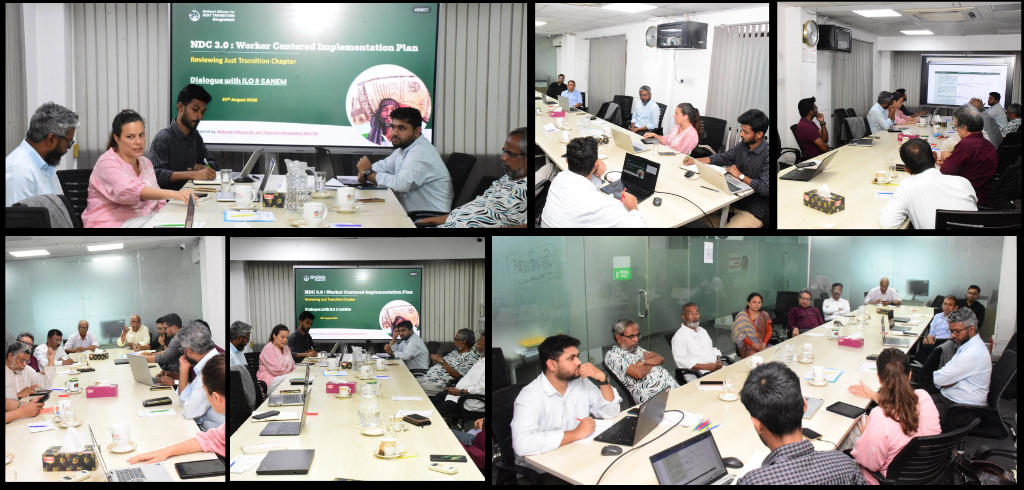
The “𝐀 𝐉𝐮𝐬𝐭 𝐓𝐫𝐚𝐧𝐬𝐢𝐭𝐢𝐨𝐧 𝐂𝐚𝐧𝐧𝐨𝐭 𝐁𝐞 𝐏𝐥𝐚𝐧𝐧𝐞𝐝 𝐟𝐨𝐫 𝐖𝐨𝐫𝐤𝐞𝐫𝐬 𝐖𝐢𝐭𝐡𝐨𝐮𝐭 𝐋𝐢𝐬𝐭𝐞𝐧𝐢𝐧𝐠 𝐭𝐨 𝐖𝐨𝐫𝐤𝐞𝐫𝐬” technical dialogue was organized on 20 August 2026 by the National Alliance for Just Transition Bangladesh (NAJTB), in collaboration with the International Labour Organization (ILO) and the South Asian Network on Economic Modeling (SANEM), focusing on the draft worker-centred implementation plan for the Just Transition Chapter of Bangladesh’s Nationally Determined Contribution (NDC 3.0).
The dialogue brought together perspectives and recommendations gathered through consultations with sectoral and RMG trade union leaders, national trade union centres, workers’ organizations, and civil society organizations to ensure that workers’ priorities inform and strengthen the implementation framework being developed by ILO and SANEM.
Advancing a Worker-Centred Just Transition Roadmap
The dialogue focused on incorporating workers’ experiences and priorities into Bangladesh’s Just Transition implementation framework, addressing the impacts of climate change, decarbonization, technological transformation, and industrial restructuring. The draft plan emphasizes decent work, employment protection, reskilling and upskilling, social protection, occupational safety and health, gender equality, and inclusive social dialogue.
Key Discussions
Ensuring meaningful participation of trade unions and workers in decision-making, implementation, monitoring, and review of the Just Transition Roadmap
Strengthening employment protection, skills development, social protection, and occupational safety and health amid climate and industrial transitions
Encouraging employers to invest in responsible transition measures, safe workplaces, skills development, and employment security
Strengthening government leadership, policy coherence, financing, and institutional coordination to support an inclusive transition
Promoting the role of civil society organizations in research, community engagement, inclusion, and independent monitoring
Adopting a tripartite-plus approach that brings together government, employers, workers, and civil society to co-design and implement transition policies
As the Secretariat of NAJTB, Bangladesh Labour Foundation (BLF) coordinated the consultation process, documented sector-specific concerns, consolidated stakeholder recommendations, and worked closely with NAJTB leaders to translate workers’ priorities into an actionable implementation plan. This process highlights BLF’s contribution to advancing labour rights, climate policy, social dialogue, and evidence-based policy advocacy.
NAJTB, a joint initiative of BLF and the Bangladesh Institute of Labour Studies (BILS), remains committed to uniting workers’ voices and advancing a just, inclusive, and rights-based transition. Through continued collaboration and meaningful worker participation, NAJTB aims to ensure that Bangladesh’s climate ambitions support a fair and sustainable future of work, leaving no worker or community behind.